Radon Without a Basement: Slab and Crawlspace Homes
Published · 10 min read
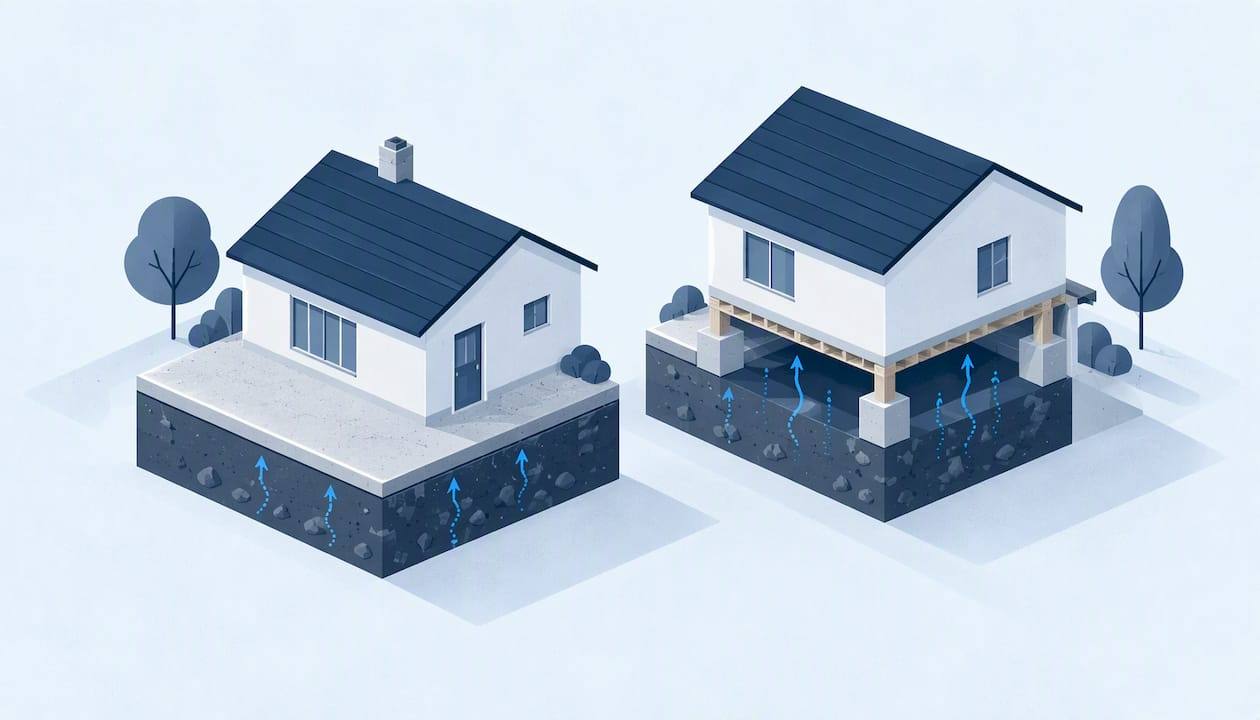
A home without a basement can absolutely have high radon. The EPA says any home can have elevated radon, and the only way to know your level is to test. Slab-on-grade houses and crawlspace houses sit on the same soil as basement houses. The gas still finds a way in, and the fix is built around your foundation type.
TL;DR
- Radon comes from soil, not from the basement. Slab, crawlspace and basement homes can all test at or above 4 pCi/L.
- Slab homes usually get a subslab suction system. Crawlspace homes usually get a plastic membrane with suction under it.
- Sealing cracks alone is not a fix. The EPA does not recommend sealing as a stand-alone method.
- Test every home, then retest after any mitigation to confirm the result.
- Levels run higher in cold months and change from house to house, so one reading is a starting point, not a verdict.
Table of Contents
- Why a missing basement does not mean missing radon
- How radon enters a slab-on-grade home
- Crawlspace homes: a different entry path
- Slab vs. crawlspace vs. basement at a glance
- How mitigation works without a basement
- When to test and what the number means
- Air quality is more than radon
- Perspective
- Getting your slab or crawlspace home tested and fixed
- FAQ
- Sources
Why a missing basement does not mean missing radon
Radon is a natural radioactive gas formed when uranium and radium in rock and soil decay. The EPA explains that it can move into homes through openings in floors and walls. Nothing about that process requires a basement. It requires soil, a pressure difference and a path.
The pressure difference is the part most people miss. Air pressure inside a house is normally lower than in the soil beneath it, which creates a slight vacuum. According to an EPA guide on radon reduction in new construction, that vacuum pulls soil gas, radon included, up into the living space. Wind, indoor heating and exhaust fans all change how strong the pull is.
The EPA's own builder guidance is blunt about construction types: all conventional types, including slab-on-grade and crawlspace homes, have been found with radon above 4 pCi/L. So "we don't have a basement" is not a reason to skip the test.
The basement does have one disadvantage
Basements give soil gas more surface area to enter, since walls and floor both touch the ground. A federal toxicology reference notes that basements offer more opportunity for entry than slab-on-grade homes, yet both allow radon in, especially when the slab or foundation is cracked. If you want to see what that looks like in a below-grade space, our piece on why radon collects in basements covers it. Lower exposure area does not mean safe. It means your result could land anywhere, which is why a measurement matters more than an assumption.
How radon enters a slab-on-grade home
A slab house has a concrete floor poured directly on prepared ground. That slab looks solid, but it is full of small openings. The EPA's new construction guide lists the usual ones: cracks, floor-to-wall joints, control joints, and gaps around pipes or wires.
In practice, the common entry points in a slab home are:
- The joint where the slab meets the footing or wall
- Saw-cut control joints in the concrete
- Plumbing penetrations under sinks, tubs, toilets and washers
- Utility lines, electrical conduit and floor drains
- Shrinkage cracks that develop as the slab ages
- Ductwork that runs in or under the slab, where present
None of these have to be large. Radon is a gas, and the vacuum under the house works on every opening at once.
Why the "seal it yourself" idea falls short
Caulking every crack feels like the logical answer. The evidence does not support it as a stand-alone fix. The EPA's consumer guide says sealing alone has not been shown to reduce radon significantly or consistently. Older EPA field testing agrees: in three slab-on-grade houses, closing the bathtub opening reduced radon by only 33 to 49 percent in two houses and not meaningfully in the third. Sealing is useful as a companion step, because it helps a suction system work better. It is not what brings a 6 pCi/L house under 4.
Crawlspace homes: a different entry path
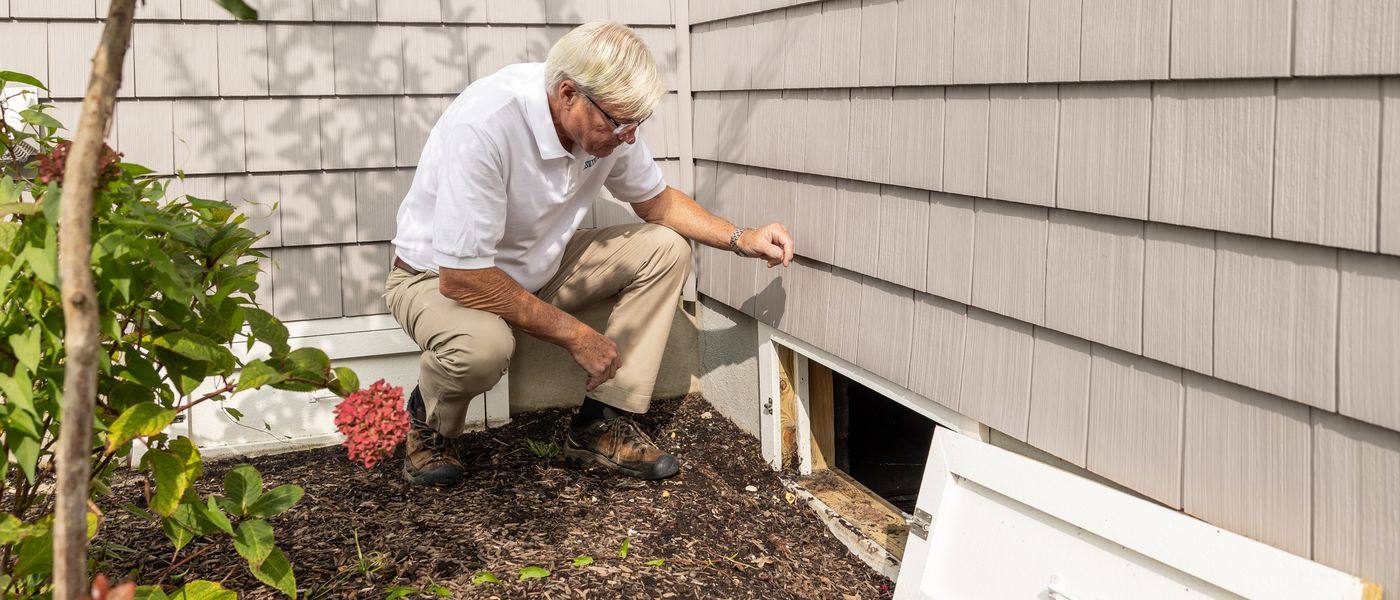
A crawlspace is often the most direct route for soil gas, because the floor is exposed earth or thin gravel. The usual assumption is that vents make it safe. The EPA's builder guide says that even with crawlspace vents, a slight vacuum pulls radon and other gases from the earth below up into the house.
That matters for older Cincinnati-area homes, which often combine a partial basement, a crawlspace and sometimes fieldstone or dirt-floor sections. We cover that situation in our guide to radon in old homes.
Slab vs. crawlspace vs. basement at a glance
| Foundation | Main entry paths | Typical mitigation approach |
|---|---|---|
| Slab-on-grade | Slab cracks, control joints, wall joints, pipe and wire openings | Subslab suction: pipe through or beneath the slab, with a fan venting outdoors |
| Crawlspace | Exposed soil floor, gaps at the rim, penetrations into the living space | Submembrane suction: sealed plastic sheeting with a vent pipe and fan |
| Basement | Floor and wall cracks, sump pits, drain tile, wall-floor joint | Subslab suction, sometimes with sump or drain tile connections |
| Mixed (slab plus crawlspace or basement) | Each section has its own paths | A design that treats each section, often with more than one suction point |
The table shows why one-size-fits-all quotes are risky. Houses with additions are common here, and an addition on a slab attached to an older crawlspace behaves like two houses sharing air.
How mitigation works without a basement
Slab homes: active subslab suction
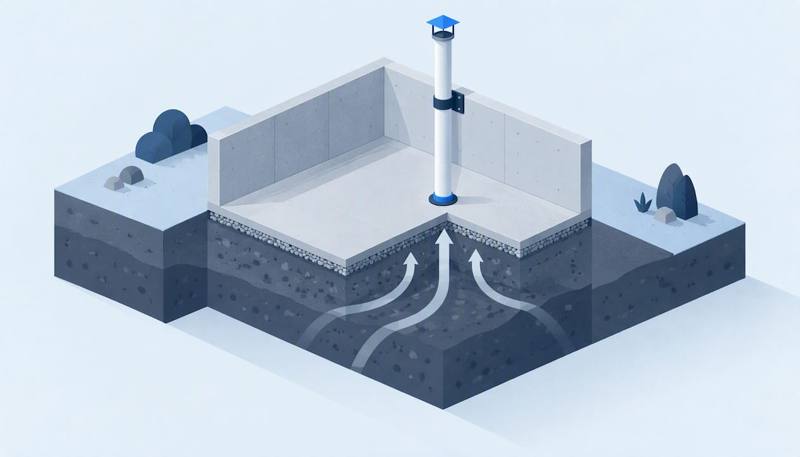
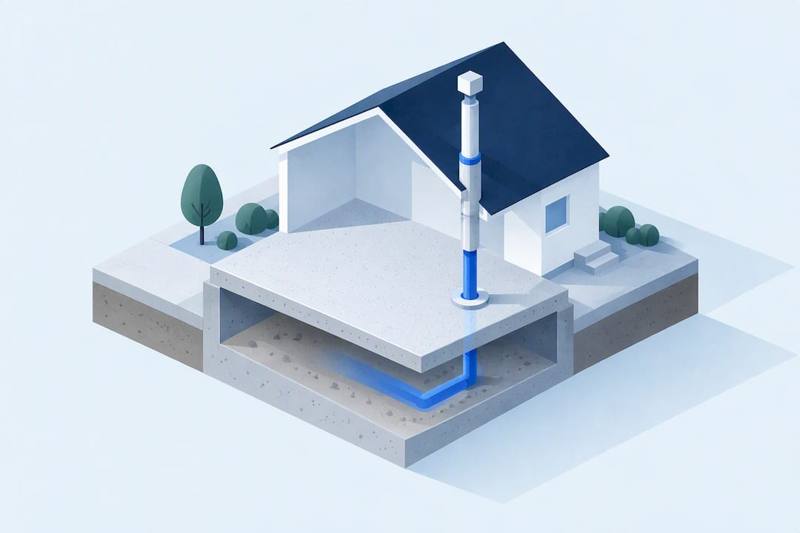
The EPA's consumer guide describes the standard approach for slab-on-grade homes: suction pipes are inserted through the slab, or below it from outside, and a fan draws radon from beneath the home and vents it outdoors. In plain terms, the system gives the gas an easier path than the one through your living room.
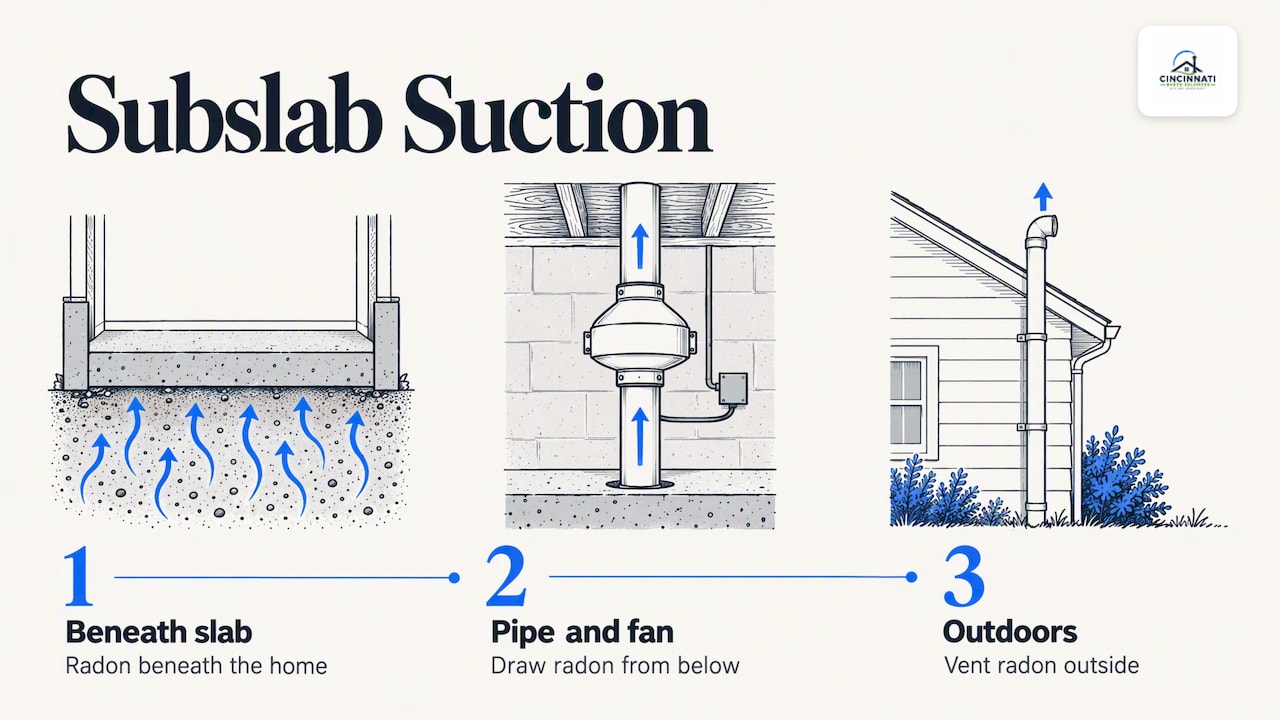
How well it works depends on how freely air moves under the slab. In EPA field testing, subslab suction achieved high reductions in houses where communication under the slab was good. That is why a competent installer checks the sub-slab material, often with a diagnostic test, before choosing the number and position of suction points. Our write-up on subslab depressurization goes through what to check in the results.
Crawlspace homes: submembrane suction
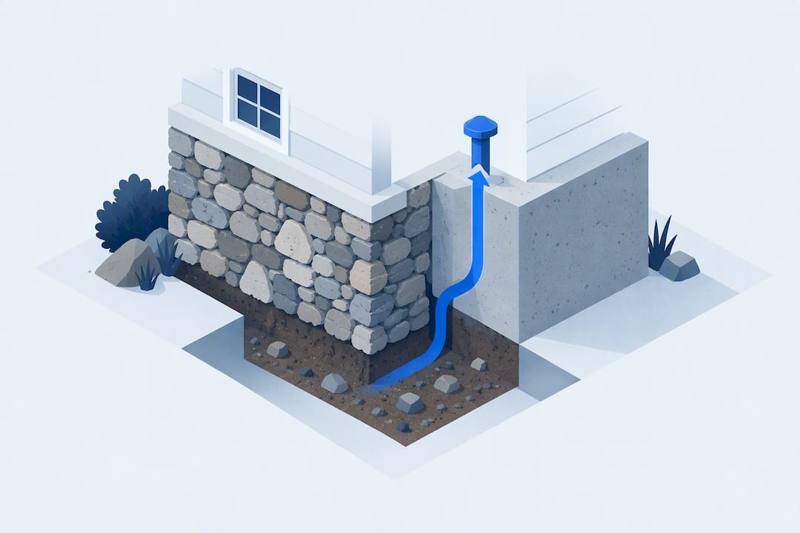
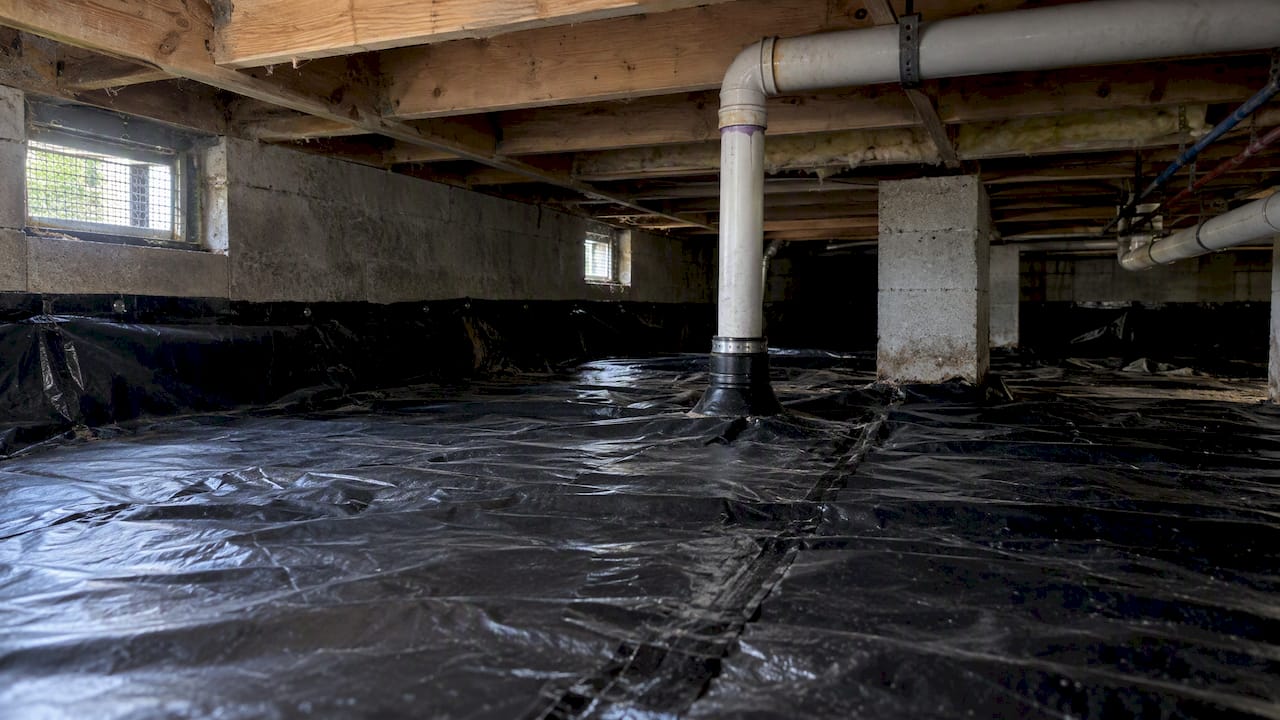
The EPA's guide describes submembrane suction as covering the earth floor with plastic sheeting, then using a vent pipe and fan to send radon outdoors. It also notes that actively depressurizing the crawlspace generally does not perform as well, and that ventilating the crawlspace may lower indoor levels. Because the membrane is what makes the suction work, its seams, edges and penetrations matter. For the full approach, see our guide to cutting crawl space radon below 4.0 pCi/L.
What about ventilation-based options?
Heat recovery ventilators come up often. The EPA's guide says they can ventilate all or part of a home, but they are more effective at reducing radon when used to ventilate only the basement. In a house without one, that makes them a weaker primary option than suction. For a side-by-side look at the whole toolkit, read how each radon mitigation system works.
When to test and what the number means
The EPA recommends that you take action to reduce radon in homes that measure 4 pCi/L or higher. Radon has no smell, color or taste, so your senses cannot stand in for a test. We explain that in what homeowners should test for at 4.0 pCi/L.
Levels move. Health Canada's measurement guide says radon is typically higher in colder months because of reduced ventilation and a stronger stack effect, and that levels also shift with habits, ventilation systems, construction and weather. The physics is the same in Ohio. A winter test in a closed-up house tends to show the conservative picture. A short-term test is a snapshot, and a result near 4 deserves a follow-up measurement instead of a shrug.
A practical testing routine for a home with no basement:
- Test the lowest level that is lived in, such as the main floor of a slab house. A crawlspace is not a living area, so the test belongs above it.
- Keep windows and exterior doors closed as the test instructions require.
- Avoid testing during unusual weather, such as strong storms or high winds, when you can.
- If the result is 4 pCi/L or above, get it confirmed or move straight to a mitigation quote.
- After any system is installed, test again.
That last step is in the EPA's guidance: test the home again after it is fixed to confirm the levels have come down. Our own radon testing service is built around that same measure-first, verify-after sequence.
Buying or selling a home with no basement
Buyers sometimes skip the test because the listing says "slab" or "no basement." That is a mistake, since the foundation type does not predict the result. In a sale, the number often drives negotiation. Our guide to radon contingency clauses explains how the 4 pCi/L line plays out between buyers and sellers.
Building new on a slab
If you are building, the cheapest time to prepare is before the slab is poured. A passive rough-in, a pipe and gravel layer set up in advance, makes later activation simple if the test shows a need. We cover timing and steps in new construction radon testing.
Air quality is more than radon
Radon is only one of several things that affect the air you breathe at home. If you are renovating a slab house anyway, it is worth looking at how interior painting affects indoor air quality too. Just keep in mind that no finish, sealant or coating replaces a radon test, and none replaces a suction system when the test is high.
Perspective
Most of the calls we get from slab and crawlspace owners start with the same sentence: "I don't have a basement, so I figured I was fine." We understand why. Radon is talked about as a basement problem, so a house without one feels outside the conversation.
What we see in the work is that the foundation decides how we design the system, not whether the house needs testing. Every mitigation we do starts with the specific house: how the slab was poured, what is under it, where the additions meet, whether a crawlspace is open to the living space. A generic system dropped onto the wrong foundation is how people end up paying twice.
That is why radon mitigation is the only thing we focus on, why our installations are ANSI/AARST certified, and why every system we install is followed by verification testing. We give a fixed written quote, so the price you agree to is the price you pay. If your number is under 4, you have your answer. If it is over, you should know the fix is routine, and it is built around your house.
Yoshua
Getting your slab or crawlspace home tested and fixed
We test and mitigate homes across the Greater Cincinnati area, including slab-on-grade, crawlspace and mixed-foundation houses. Each system is designed around the specific foundation, installed to ANSI/AARST standards, and followed by verification testing so you have a measured result and documentation suitable for a real estate transaction. Quotes are fixed and in writing, with no added costs after quoting.
Start with a radon test, or see our radon mitigation systems if you already have a result above 4 pCi/L. Already have a system whose fan has stopped or gotten loud? We handle radon system repair and fan replacement as well. You can see everything we do on our services page.
FAQ
Do I need a radon test if my house has no basement?
Yes. The EPA recommends testing all homes, and a test is the only way to know your level. Slab-on-grade and crawlspace homes have both been found above 4 pCi/L, so foundation type is not a safe shortcut.
What time of year is radon worst?
Levels are typically higher in colder months, when windows and doors stay closed and the stack effect draws more soil gas in. Levels also vary with weather and with how the house is used. If a test lands close to 4 pCi/L, a follow-up measurement is worth doing.
Does radon rise from the basement to the upper floors?
Radon enters from the soil beneath the home and spreads through the living space. It does not need a basement to start. In a slab house, it comes up through the slab openings directly into the rooms. Levels are often highest on the lowest lived-in floor.
How is radon fixed in a crawlspace?
The common approach is submembrane suction: plastic sheeting over the earth floor, with a vent pipe and fan that send the gas outdoors. Ventilating the crawlspace can also help, but actively depressurizing it generally does not work as well. A professional should size and seal the system to your crawlspace.
Can I just seal the cracks in my slab?
Sealing helps a suction system perform, but the EPA does not recommend it as the only method. It has not been shown to lower radon significantly or consistently. If your test is 4 pCi/L or higher, plan for a system and retest afterward.
Sources
- Radon in Homes, Schools and Buildings, US EPA
- Radon Reduction in New Construction: an Interim Guide, US EPA
- Radon Toxicity: Annex I, Methods of Detection, ATSDR/CDC
- Building Radon Out: Step-by-Step Guide, US EPA
- Consumer's Guide to Radon Reduction, US EPA
- Testing of Indoor Radon Reduction Techniques in Central Ohio and Florida Houses, US EPA
- Guide for Radon Measurements in Residential Dwellings, Health Canada
- Why Interior Painting Improves Air Quality at Home