
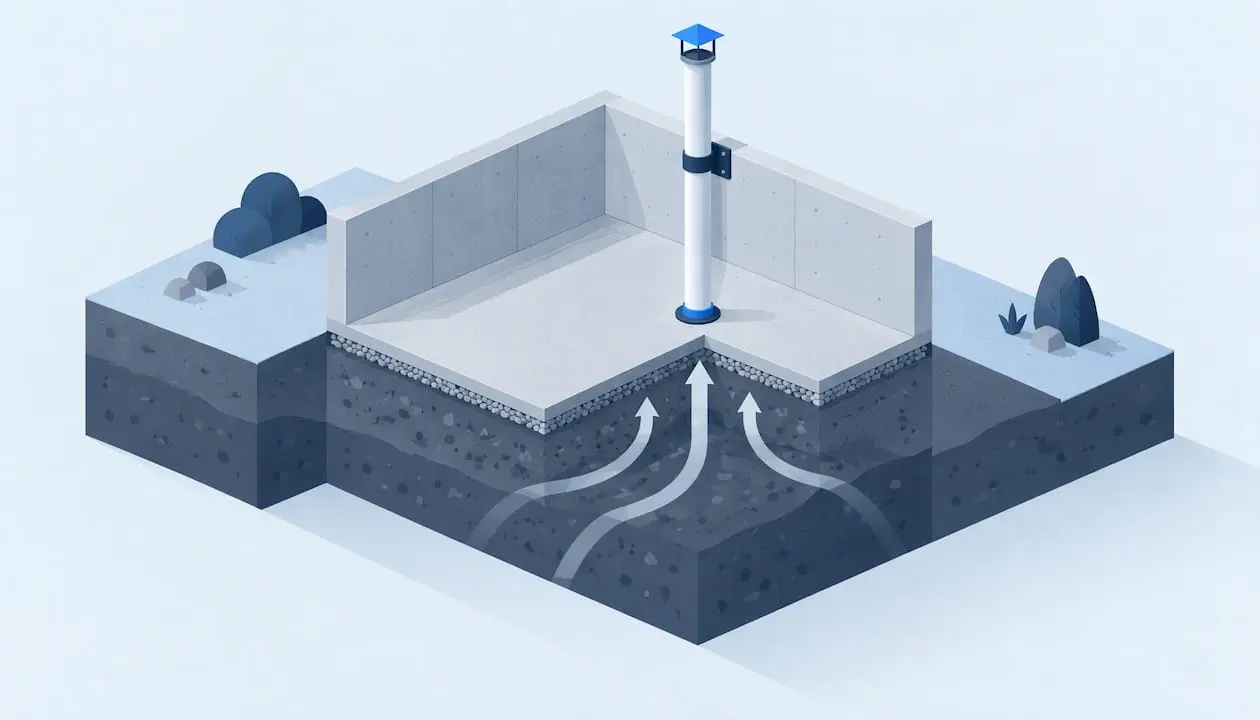
Radon collects in basements because the basement is the part of your house closest to the soil it comes from. Gas released by the ground is pulled in through cracks, joints, drains and sump pits. The fix is a proven one: test, and if the result is 4 pCi/L or higher, have a soil suction system installed, with the sump pit sealed and part of the system, then retest to confirm it worked.
TL;DR
- Radon is a natural radioactive gas from soil and rock. It is invisible and odorless, and basements are where it most often enters and builds up.
- The risk is long-term, not immediate. The CDC says breathing high levels over time may cause lung cancer, which takes many years to develop.
- The EPA action level is 4 pCi/L. Test the lowest level of the home, and mitigate if the result is at or above that number.
- Most basement fixes use a fan that pulls soil gas from under the slab or from the sump pit and vents it above the roofline. An airtight sump cover is part of that system.
- Always retest after installation to verify the system works.
Table of Contents
- Why radon ends up in your basement
- How dangerous is basement radon?
- How to test a basement for radon
- How basement radon mitigation works
- Sump pits, sump pumps and radon covers
- What to expect during basement mitigation
- Building new: rough-ins keep the basement ahead of the problem
- Perspective
- Work with a Cincinnati radon specialist
- FAQ
- Sources
Why radon ends up in your basement
Radon is an odorless, invisible radioactive gas that naturally releases from rocks, soil and water. Outdoors it disperses harmlessly. Under a house it does not. The soil gas sits in the ground around and beneath your foundation, and your house acts like a weak vacuum.
Warm air rises and leaks out through the upper floors and attic. That pulls replacement air in from the lowest points, and the lowest point is the basement. Whatever is in the soil gas comes along with it. This is called the stack effect, and it is strongest in winter, when the heating system is running and the house is closed up.
The entry points in a typical basement are easy to list:
- Cracks in the slab and in the foundation walls
- The joint where the floor meets the wall
- Gaps around pipes, wires and other penetrations
- Floor drains
- Hollow-block walls
- Open or loosely covered sump pits
- Water supplies, which can carry radon that releases into the air when water is used, including during showers
Cracks and openings are not a sign of a poorly built house. Every concrete slab shrinks and settles, and every foundation has penetrations. If you want to understand how other foundation defects create paths for moisture and gas, this overview of types of foundation problems is a useful companion, though only a test can tell you whether radon is actually getting in.
Does radon stay only in the basement?
No. Radon concentrations tend to be highest on the lowest level, but it moves through the whole house, and homes without basements, including slab-on-grade houses, can have high readings too. Radon levels also vary enormously from one house to the next, even between neighbors with the same floor plan. A neighbor's low result tells you nothing about yours.
How dangerous is basement radon?
Radon is not an acute hazard. You will not feel it, and an elevated reading does not call for an emergency. The danger is cumulative. Inhaled radioactive particles can damage the cells lining the lung, and over years that damage can lead to cancer. Radon is the second leading cause of lung cancer in the United States.
Two points matter for how you act:
- There is no known safe level. The CDC says homeowners should aim for the lowest indoor concentration they can reasonably achieve.
- Time spent in the space counts. A finished basement used as a bedroom, playroom or home office means many hours a day at the highest concentration in the house. An unfinished basement you visit to do laundry is a different exposure. Both are worth testing.
Because the harm builds slowly, there are no early signs to watch for. Our guide on radon exposure symptoms explains why cancer can take 5 to 25 years to develop and why a test is the only meaningful early step. And since you cannot sense it, radon has no smell that would warn you.
Opening windows or running a fan in the basement is not a plan. The reading changes with weather and house conditions, and ventilation is not a reliable long-term fix. Measure, then fix the source.
How to test a basement for radon
Testing is the only way to know. You can hire a professional or use a test kit. Per the CDC, the basics are:
- Test in the lowest level of the home that you use or could use.
- Place the device about 3 feet off the floor, away from drafts, exterior walls, and humid spots like bathrooms and laundry areas.
- Short-term tests run 2 to 90 days. Long-term tests run more than 90 days and show a truer yearly average.
- A result at or above 4 pCi/L calls for follow-up testing and action.
A few practical notes from the field:
Keep the house closed. Short-term tests assume normal closed-house conditions, so windows stay shut except for ordinary entry and exit during the test.
Placement matters. A kit sitting on the floor behind the furnace tells you something different from one on a shelf in the middle of the room. We cover this in where to put your radon test.
Duration matters. Radon fluctuates day to day. A short test is a snapshot, and a borderline result deserves a longer look. See why 48 hours may not be enough.
Confirm before you spend. A single reading at 4 pCi/L is a reason to verify, not to panic. Here is how to confirm your radon test results before deciding on a system.
If you are buying or selling, the CDC notes that the EPA recommends hiring a qualified professional for real estate transactions. That gives both sides a result that is placed correctly and documented. We offer professional radon testing across the Greater Cincinnati area.
What the numbers mean
| Result | What to do |
|---|---|
| Below 2 pCi/L | No action required. Retest periodically and after major renovations. |
| 2 to 4 pCi/L | Below the action level, but the CDC and EPA note that action can be considered. |
| 4 pCi/L or higher | Follow-up test, then contact a qualified mitigation professional. |
| Any mitigated home | Retest after installation to confirm the reduction. |
How basement radon mitigation works
The standard approach is soil depressurization. A fan creates a low-pressure zone beneath the slab so soil gas is drawn away from the house instead of into it. The EPA describes an active system as having a fan, with a vent stack running from a suction pit under the slab to the roof. The gas is released above the roofline, where it disperses.
The EPA's consumer guidance says that in homes with a basement or slab-on-grade foundation, radon is usually reduced by one of four types of soil suction: subslab suction, drain-tile suction, sump-hole suction or block-wall suction. Which one fits depends on what is under and around your basement:
| Basement condition | Typical approach |
|---|---|
| Poured slab over gravel or permeable soil | Sub-slab suction: a pipe through the slab into the gravel, fan outside or in the attic |
| Perimeter drain tile and sump pit | Sump pit or drain-tile suction, with the pit sealed airtight |
| Hollow concrete block walls | Block-wall suction, often combined with sub-slab suction |
| Dirt or partial crawl space area | Sealed membrane with suction beneath it |
This is why we do not install a one-size-fits-all kit. Soil, slab, drainage and footing details differ from house to house, and diagnostic testing under the slab shows how far a single suction point will reach. Our overview of how each radon mitigation method works walks through the options in more detail.
Sealing is part of the job
Suction does the heavy lifting, but sealing makes it efficient. The fewer openings between the soil and the house, the more of the fan's pull reaches the soil gas. Specifications in the EPA's Energy Star indoor air package call for foundation openings, penetrations and control or expansion joints to be sealed with polyurethane caulk or equivalent. Sealing alone rarely brings a high reading down enough, so it supports a suction system and does not replace one.
Sump pits, sump pumps and radon covers
Sump pits are one of the most common questions we get about basements, and they are a common weak spot. A sump pit sits in the slab and connects to the soil and drain tile below. An open pit or a loose lid is a direct opening to the gas under the house.

Can a sump pit be part of the radon system?
Often, yes. In a basement with a perimeter drain and a sump pit, the drain tile can carry suction to much of the slab perimeter. The mitigation pipe connects to the sealed pit, and the fan pulls soil gas through it. You keep your sump pump. It continues to remove water as before.
What a radon sump cover does
A radon sump cover is an airtight lid that seals the pit so the fan pulls from the soil instead of from your basement air. The EPA's Energy Star specification states that a sump-pump cover shall be air sealed, for example by mechanical attachment with a full gasket seal or equivalent. A snap-on plastic lid with gaps does not meet that standard.
A good installation of a sealed sump cover includes:
- A rigid lid with a gasket around the rim
- Sealed openings for the pump's discharge pipe, power cord and any float switch wiring
- A port for the radon suction pipe
- A clear or removable design so the pump can be inspected and serviced
- A fitting that allows water to enter the pit from the drain tile without letting air out
Use flexible, removable sealant at the penetrations. You will need to lift the lid for pump maintenance, and a permanent sealant can force you to break the seal each time.
Do not seal the pit without thinking about water
The pit has a job: collecting water and protecting your basement from flooding. A sealed lid must not block the pump, trap the float switch, or stop the discharge line. If the pit has an air gap or vent that was installed for the pump, it needs to be handled properly rather than simply plugged. This is why sealing a pit is best done as part of a designed system. A pump that cannot cycle freely is a flooding problem in the making, and a leaky lid is a radon problem.
If you already have a mitigation system and the pump lid is cracked, unsealed or missing, that is worth fixing promptly, because the system's performance can drop. Our radon system repair and fan replacement service covers fans, seals and related components.
What to expect during basement mitigation
A typical project follows these steps:
- Test and confirm. A valid result at or above 4 pCi/L, ideally confirmed with a second test.
- Inspect the basement. Slab condition, sump pit, drain tile, block walls, floor drains, the route for the pipe and the fan location.
- Design the system. Suction point locations, pipe route, fan placement outside the living space (attic, garage or exterior wall) and exhaust above the roofline.
- Install. Core the slab, seal the pit and cracks, run the pipe, mount the fan, add a manometer or other indicator so you can see it is running, and label the pipe.
- Verify. Test after installation to make sure levels fell. The CDC and EPA say retesting after mitigation is necessary in all cases.
- Maintain. Check the indicator now and then, and retest periodically, since fans wear out and house conditions change.
We can walk you through our radon mitigation systems, and if cost is on your mind, our radon mitigation cost guide for Cincinnati explains what drives the price.
Building new: rough-ins keep the basement ahead of the problem
If you are building, adding radon features during construction is easier than retrofitting. The EPA says radon-resistant construction uses common materials and techniques, with no special skills required. A passive system typically includes a gravel layer, polyethylene sheeting, a vent pipe labeled "Radon System," and sealed foundation joints.
Passive does not mean tested. The EPA advises testing a new home immediately after moving in to make sure levels are below the guideline. If the number is high, a fan can be added to the rough-in pipe, turning it into an active system. See why new homes need a radon test too.
Perspective
Most basement radon problems we see are not mysteries. They are the sum of a slab, a sump pit, some block walls and a stack effect that has been pulling soil gas into the house for decades.
That is why we treat every basement as its own design problem. We measure, look at the foundation and the pit, and design the suction points for that house. The system is only finished when a post-installation test shows it works, and every mitigation we do includes that verification.
We focus on radon and nothing else, and our installations follow ANSI/AARST standards. We give fixed written quotes, so you know the scope before work begins, and we leave you with documentation that works for a real estate transaction. If your basement has a sump pit, we make the sealed pit part of the plan from the start rather than an afterthought.
Yoshua
Work with a Cincinnati radon specialist
If you have a test result at or above 4 pCi/L, or you are about to buy or sell a home with a basement, we can test, design and install a system for your foundation, then verify it. See our radon services or contact us for a written quote.

Our work includes residential mitigation, verification testing, home-sale testing and mitigation, rough-ins for new builds, and repairs on existing systems.
FAQ
Is radon in a basement an emergency?
No. Radon is a long-term health concern, not an acute hazard. The CDC explains that lung cancer from radon takes many years to develop. Still, do not wait: confirm the level and have it fixed if it is at or above 4 pCi/L.
Do I need a radon system if my basement is finished?
Finishing a basement does not remove radon. Drywall, carpet and paint do not reliably block soil gas, and gas can still enter through the slab and walls. Test the finished space, and if it is high, a suction system can usually be installed with limited disruption.
Can I just seal the cracks myself?
Sealing is useful, but cracks are only some of the entry points, and the EPA's specifications treat sealing as a supporting measure. A high reading is best addressed with a suction system. Sealing is then done as part of that system, and a retest confirms the result.
Does a radon system affect my sump pump?
It should not. The pump keeps working as before, and the pit gets an airtight cover with sealed openings for the discharge line and cord. The pit must stay serviceable so the pump can be checked and replaced.
How soon should I retest after mitigation?
Test after the system is installed to verify it. Per the CDC, retesting is necessary after mitigation. After that, retest periodically and whenever the fan is replaced or the house is renovated.
Sources
- Radon and Your Health, CDC
- Testing Your Home for Radon, CDC
- Radon and Cancer, National Cancer Institute
- Clinician Brief: Radon, ATSDR
- Radon Prevention in the Design and Construction of Schools, EPA
- Energy Star Indoor Air Package Specifications Version 2, EPA
- Radon-Resistant Construction Basics and Techniques, EPA
- How to Address Radon When Building a New Home, EPA