
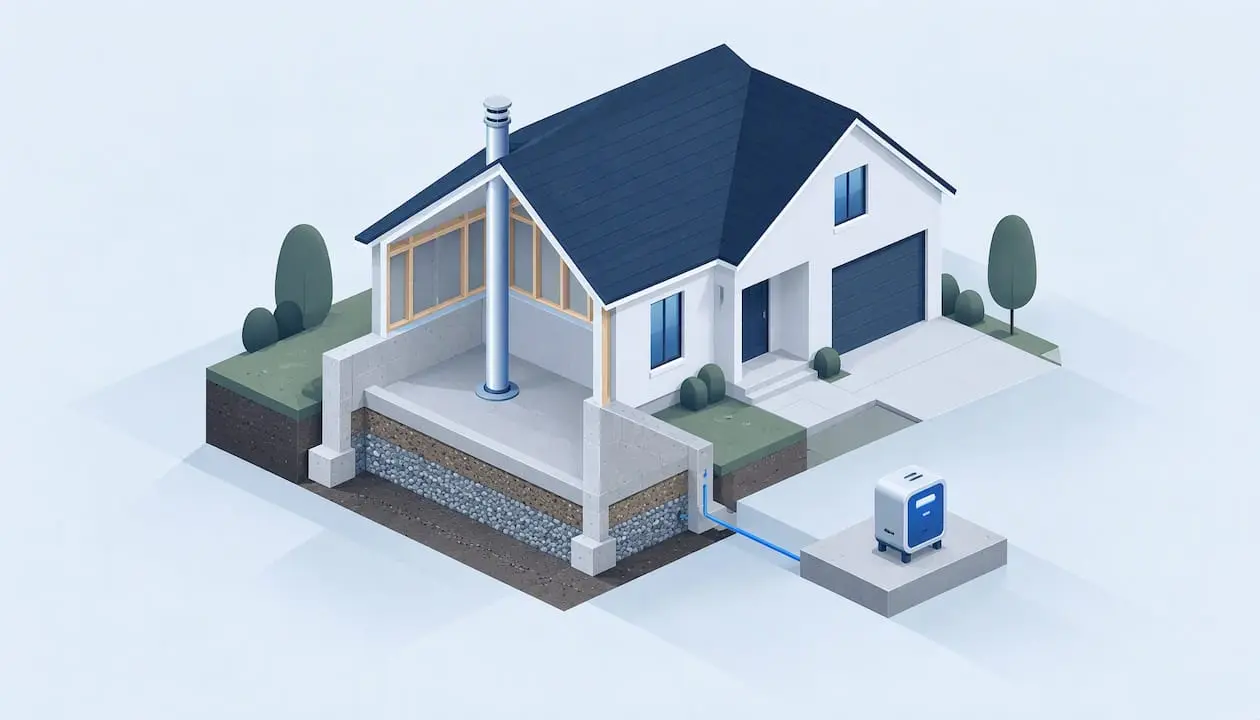
A new home should be tested for radon even when the builder installed radon-resistant features. The EPA recommends testing every new home, right after you move in, and the reason is simple: the passive pipe and gravel under your slab are built to reduce radon, but only a measurement tells you what is in the air your family breathes. This guide covers when to test, how to test a slab-on-grade house, what the builder should have installed, and what to do if the number comes back high.
TL;DR
- Radon-resistant construction lowers risk but does not guarantee a result under 4 pCi/L. Every new home needs a test.
- Test as soon as you move in, in the lowest level you will use regularly, with doors and windows closed under the test protocol.
- A short-term test runs at least 48 hours. A result of 4 pCi/L or higher means the passive system should be activated with a fan.
- Soil testing before you build is not a reliable way to decide whether to build radon-resistant.
- If the house has a rough-in, activating it is usually a smaller job than retrofitting a home with no system.
Table of Contents
- Why a brand-new house still needs a radon test
- What a radon-resistant new home actually includes
- When to test a new home
- How to test a slab-on-grade home
- Reading the result: what counts as high
- If the test is high: activate the rough-in
- Should you test the soil before building?
- Perspective: what we see on new builds
- Notes for builders and agents
- Test your new home with us
- FAQ
- Sources
Why a brand-new house still needs a radon test
Radon is a radioactive gas that forms as uranium in soil and rock breaks down. It moves up through the ground and enters a house through the slab, cracks, sump pits, utility penetrations and any gap in the foundation. It is the leading cause of lung cancer among non-smokers, and you cannot see or smell it.
New houses are not exempt. Modern homes are built tight to save energy, which can reduce the air that leaks in and out. Tighter envelopes can let radon that does enter linger longer. Whether a house is 3 months or 90 years old, what matters is the pressure difference between the house and the soil, the soil's radon potential and the quality of the seal against the ground. None of those are visible from a walk-through.
The EPA's guidance for buyers is blunt on the point: radon-resistant techniques can help reduce levels, but every new home should be tested. An older EPA standards document made the same case from a technical angle: passive systems can bring most homes below 4 pCi/L, but they are not a guaranteed solution. Our own write-up on why to test a brand-new house goes deeper on the building-science side.
In the Greater Cincinnati area, the geology makes this more than a formality. Hamilton County and its neighbors sit in a region where elevated indoor radon is common, and the EPA's radon zone map and state program resources are the place to check your own county's rating and Ohio's licensing program for testers and mitigators.
What a radon-resistant new home actually includes
Radon-resistant new construction (often abbreviated RRNC) is a set of passive features added while the house is being framed and poured, when they cost the least. The EPA notes that building these features in is significantly more cost-effective than retrofitting later.
For basement and slab-on-grade foundations, the basic package described in the EPA's new-home buyer guide is:
- A gas-permeable layer, typically 4 inches of clean gravel, under the slab.
- Plastic sheeting over the gravel, under the concrete.
- Sealing and caulking of openings in the foundation below grade.
- A 3- to 4-inch vent pipe running from the gravel layer up through the house and out the roof.
- An electrical junction box in the attic, so a fan can be wired in later if needed.
Without the fan, this is a passive system. Warm air rising in the pipe creates a mild draw, which helps in some houses and not enough in others. That is why the fan junction box matters: it is the planned path to an active system.
Which standards and codes apply
The EPA lists several recognized approaches: International Residential Code Appendix F, ASTM E1465-08 and ANSI/AARST RRNC 2.0. Appendix F only applies where a state or local jurisdiction adopts it, so a house in one county may be required to have a rough-in and a house in the next may not. EPA's builder resources explain that ANSI/AARST CCAH-2020 and RRNC-2020 set minimum requirements for rough-ins, and CCAH also covers verification and activation in new dwellings. The RRNC-2020-1022 update added a specific requirement to test for radon once construction is complete.
If you want the standards context for testing after completion, this overview of radon testing after construction walks through how the newer new-construction standard treats testing.
When to test a new home
The answer for most buyers is: right after you move in. The EPA says to test as soon as possible after occupancy, because that is when the house is closed up and operating the way you will live in it.
A few practical timing points:
- Before closing, if the contract allows it. A test during a transaction gives you a number to negotiate with. If the builder is still on the hook for the rough-in or activation, you want the result before that leverage is gone.
- After final grading, HVAC startup and utility connections. A test run in a half-finished house does not represent how it will perform with the furnace running and the doors in use.
- Again later. The EPA suggests retesting periodically and after renovations that change the foundation or the HVAC system. If you finish a basement, add an addition or replace the furnace, test again.
Do not rely on the builder's number alone
A builder may offer a test from the end of construction. That can be useful data, but you should know who ran it, which device, for how long, and under what conditions. A test taken in an unoccupied house with the HVAC off can misrepresent how the house will behave once you move in. An independent test is your own record.
How to test a slab-on-grade home
A slab-on-grade house has no basement, so the slab is the main entry route for radon. The test itself follows the same protocol as for any home.
Where to put the device
Place it in the lowest level that could be used regularly. In a slab-on-grade house, that is usually the main floor: a living room, den or bedroom, not a bathroom, kitchen, laundry room or closet. Keep it off the floor, away from drafts, exterior walls, vents and sunlight, at breathing height, roughly 20 inches to 6 feet up.
Closed-building conditions
For short-term tests of 2 to 4 days, the protocol is to keep the house in closed-building conditions for 12 hours before and throughout the test. That means windows and exterior doors closed except for normal entry and exit, and no whole-house fans or window air conditioners that bring in outside air. Your regular heating and cooling system can run normally.
How long to run it
Short-term tests run at least 48 hours, and some devices require longer. Short-term tests span 2 to 90 days across the device types in EPA guidance. When a short test runs beyond 2 days, the AARST measurement standard says it is best to end it at a 24-hour increment from the start time, so a test started Monday at 9 a.m. ends at 9 a.m. on a later day.

We get asked often whether 48 hours is enough. It is the minimum, and radon varies with weather and season, so longer is better when you have the time. We explain the trade-offs in our piece on why 48 hours may not be enough.
Two devices or a continuous monitor
For real-estate decisions, the EPA guide notes that results can be based on the average of two simultaneous tests or a continuous radon monitor. Two side-by-side devices reduce the chance that one faulty result drives a bad decision, and a continuous monitor shows hourly readings that reveal tampering or open windows.
DIY kit or professional test
A home kit is fine for a personal check. If the result will be used in a sale, a refinance or a dispute with the builder, a professional test with a documented chain and a calibrated monitor is easier to defend. See our radon testing service.
Reading the result: what counts as high
The EPA action level is 4 pCi/L. An elevated level is 4 pCi/L or higher. A reading under 4 does not mean zero risk, since there is no known safe level of radon, but it is the line where action is recommended.
| Result | What it means | Next step |
|---|---|---|
| Below 4 pCi/L | Under the action level | Retest periodically and after renovations |
| 4 pCi/L or higher | Elevated | Confirm if needed, then activate the rough-in or install a system |
| Very high short-term result | Possibly a spike from weather or conditions | Run a follow-up test promptly rather than wait |
If you have a high reading, do not just crack a window. Opening windows may lower a reading briefly, but it is not a dependable fix, and it ruins test conditions if you do it mid-test.
If the test is high: activate the rough-in
If your new home has the rough-in described above and the test hits 4 pCi/L or more, the EPA recommends activating the system by adding a vent fan. A fan in the attic or on the exterior pulls soil gas through the gravel layer and vents it above the roofline, which is a much stronger draw than a passive pipe.
After activation, test again. A fan that is running tells you nothing about air quality until a follow-up measurement confirms the level is down. Our mitigation work always ends with verification testing, because installing a system and proving it works are two different things.
If your house has no rough-in, or the pipe was run but poorly sealed, a full radon mitigation system designed for your foundation is the next step. For a sense of budget, see our Cincinnati radon mitigation cost guide. And if you already have a fan that has quit or is making noise, system repair and fan replacement is a separate, quicker service. When something seems off, our eight-point check for a system that isn't working is a good first pass.
Should you test the soil before building?
If you own a lot and are planning a build, soil testing seems logical. The EPA says otherwise: soil testing is not recommended for deciding whether to build radon-resistant. It cannot rule out radon problems in the finished house, because site preparation, backfill and the building itself change how much radon enters. The EPA also notes that a single soil test costs $70 to $150, and four to eight tests could be needed to characterize one site.
The better use of that money is the radon-resistant package itself, which is cheap during construction, followed by a test of the finished house.
Perspective: what we see on new builds
We focus only on radon, and new homes are one of the places where we see the biggest gap between what people assume and what is true. Many buyers hear "radon-resistant" and read it as "radon-free." It is not. The rough-in is a good start, but a pipe through the attic is only as good as the sealing, the gravel layer, and the way the slab was poured around it.
Our approach is to measure first and design from the measurement, not from a template. A house with a tight slab and good sub-slab communication may need one suction point. A house with footings that split the gravel into sections, or with a finished basement over a poorly connected slab, can need more. That is why we build systems around the foundation we find, give fixed written quotes, and finish with a verification test.
For builders and agents, the practical advice is to run the rough-in carefully, label it, and plan for a post-completion test. It protects the homeowner and it protects you from a callback.
— Yoshua
Notes for builders and agents
Builders. Install the rough-in to the standard your jurisdiction uses, seal the penetrations, keep the pipe continuous to the roof, and leave the attic junction box accessible. If you want help with the rough-in stage, we offer rough-ins for new builds. Test at completion, and give the buyer the result.
Agents. A new-construction sale still needs a radon result that the buyer and lender can rely on. Get the test scheduled early, under closed-building conditions, so it doesn't delay closing. We provide documentation suited to real estate transactions through our radon-during-a-home-sale service.
Test your new home with us
If you just closed on a new house in Greater Cincinnati, or you are about to, we can test it, tell you in plain language what the number means, and design an activation or full system if you need one. Every mitigation we install is ANSI/AARST certified work and includes post-installation verification testing. Start at our radon testing page or see everything on our services page.
FAQ
Are new homes built with radon mitigation systems?
Some are, depending on local code and the builder. Many have a passive rough-in (gravel, sheeting, sealed openings and a vent pipe), but it is not a complete mitigation system until a fan is added and a test confirms the result. Ask the builder in writing what was installed.
Do most home inspections include radon testing?
Not by default. Radon testing is usually an add-on that the buyer orders, and it is separate from the standard inspection. In a new-construction deal, ask for it early so the timing fits the closing schedule.
Does opening a window get rid of radon?
Not reliably. Ventilation may lower levels for a short time, but it is not a dependable long-term fix, and it changes the conditions of any test in progress. A properly designed system is the way to reduce radon steadily.
How long should a new-home radon test run?
A short-term test runs at least 48 hours, and longer is better when your schedule allows. Keep closed-building conditions for 12 hours before the test and throughout it, and place the device on the lowest regularly used level.
Sources
- EPA: Home Buyer's and Seller's Guide to Radon, buying a new home (PDF)
- EPA: Model Standards and Techniques for Control of Radon in New Residential Buildings (PDF)
- EPA: Builder and Contractor Resources for Radon-Resistant New Construction
- EPA: How to Address Radon When Building a New Home
- EPA: Should I test the soil for radon before building?
- EPA: Map of Radon Zones and Supplemental Information
- AARST: ANSI/AARST MAH-2019, Measurement standard