How to Hide a Radon Pipe Without Hurting the System
Published · 13 min read

You can make a radon pipe far less noticeable. You can paint it, screen it with plants or a vented panel, or route it through a closet, chimney chase or wall. What you cannot do is block the vent opening, box in the fan, or bury the pipe where nobody can reach it. The goal is a pipe that fades into the house and still moves radon out of the ground and away from your windows.
This guide covers the options for exterior and interior pipes, how to paint one, what must stay open and visible, and what to decide before an installer arrives if you are planning a new system.
TL;DR
- Painting and landscaping are the easiest fixes for an exterior pipe. Keep the vent opening, the fan and any service access clear.
- Interior routing (closets, walls, chases) hides the most, but it should be planned with the installer, not improvised afterward.
- Never enclose a fan airtight, and never put a fan in or below living space.
- Labels on the system should stay visible, and any change to the pipe's path or discharge point needs a radon professional.
- The cheapest time to hide a pipe is before it is installed. Tell your installer what bothers you at the quote stage.
Table of Contents
- Why the pipe is where it is
- Hiding a radon pipe outside
- Hiding a radon pipe inside
- What must stay open, visible and reachable
- Ideas that look good but cause trouble
- We believe the best hiding job is a planned one
- If you are buying, building or remodeling
- Test after any change near the system
- When to call a radon professional
- Want it hidden properly?
- FAQ
- Sources
Why the pipe is where it is
A radon mitigation system pulls soil gas from beneath the foundation and sends it through a pipe to a point where it can disperse. That pipe is not decoration that someone forgot to hide. Its path and its end point are part of how the system works.
Rules differ by state and by the standard the installer follows, but they share a pattern. Iowa's published requirements, for example, put the discharge of an active system above the roof eave, at least 10 feet above the ground, and at least 10 feet from any opening that sits less than 2 feet below the exhaust point (Iowa HHS vent pipe requirements, 2022). The same document calls for vent stacks to discharge vertically and upward, which keeps heavy snow and water from blocking the opening.
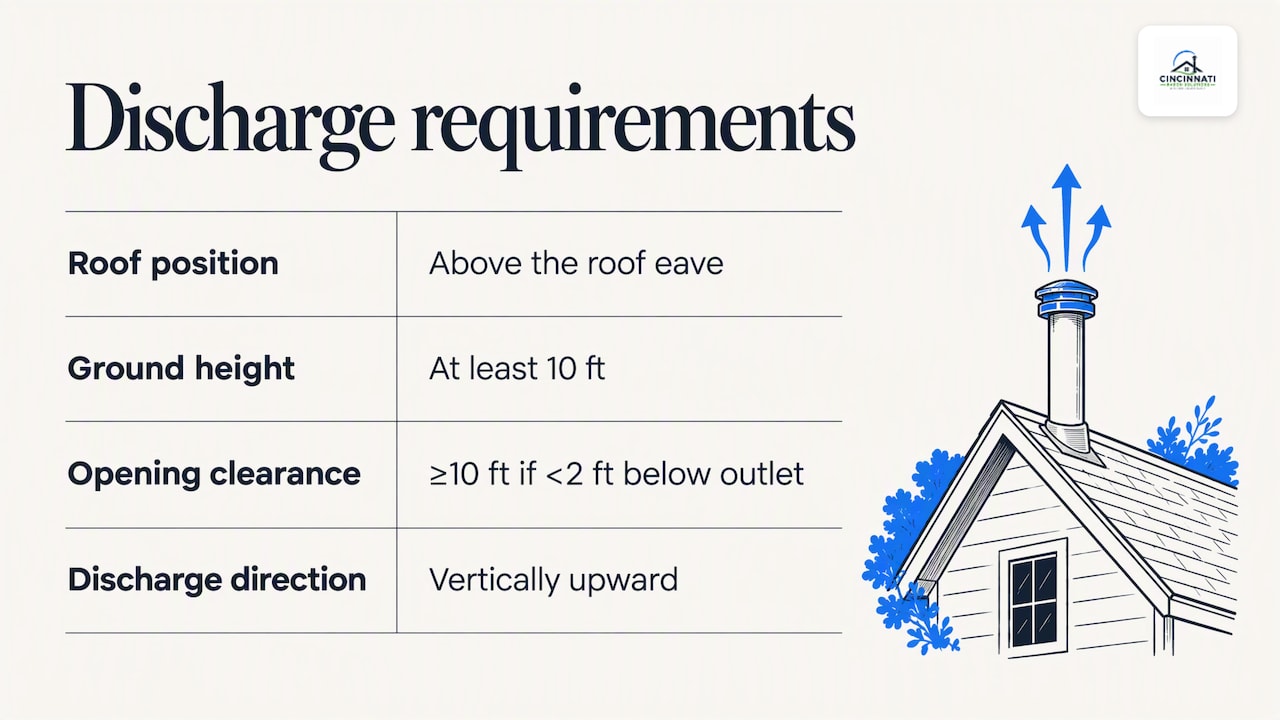
That is why a pipe that "just ends" at the side of the house, or one capped with a decorative hood, is a problem. Ohio homes follow their own rules and the installer's standard, so ask us or your installer what applies to your address before you change a discharge point.
The practical takeaway: the middle of the pipe is where you have freedom. The top and the fan are where you have limits.
Hiding a radon pipe outside
Exterior pipes are the ones people notice most, usually a white or gray 3 or 4 inch PVC run up a wall. Four approaches work, from easiest to most involved.
Paint it to match the siding
Painting is the most common answer to the "paint radon pipe" question, and it is usually fine. The general guidance is to use an exterior-grade, UV-resistant paint made for PVC in a color that matches your siding or trim (plumbinginto.com). Before you start:
- Clean and scuff the pipe. PVC is slick. Wipe it down and lightly sand it so the paint grips.
- Pick a paint labeled for plastic or PVC. Ordinary wall paint peels within a season or two.
- Keep labels readable. Mask the system label or repaint around it. Do not cover it.
- Leave joints and the vent opening alone. Do not let paint or caulk build up in couplings, and keep the opening itself clear.
- Do not paint the fan housing unless the manufacturer says it is fine. Fans shed heat, and some housings have markings you need.
Dark colors on a sun-facing wall can run hotter. A shade close to your trim or brick usually blends better than trying to match a bright siding color exactly.
Run it where the eye does not go
If the system is not installed yet, the best fix is placement. Exterior pipes tend to disappear in a few spots:
- Inside corners where two walls meet, so the pipe sits in a shadow line.
- Beside a downspout, where a vertical pipe reads as part of the gutter system.
- Along a chimney or chase. Brown or color-matched piping next to masonry draws little attention.
- The side or rear of the house that faces a fence line, not the street.
The pipe must still end up above the roofline and clear of windows and other openings, so placement near a gable end or a chase often beats a front corner. Tell the installer which sides of the house you care about. A site visit lets us trace where the pipe can run from the suction point under the slab, and that route decides most of what you will see outside. Our radon system design approach starts from the foundation tests, then picks the least conspicuous route that still performs.
Screen the lower section with plants or planters
Landscaping is a good way to soften the bottom of an exterior pipe. Shrubs, a trellis or a raised planter in front of the lower run can break up the line without touching the system (plumbinginto.com). If you want ideas for planting that does not demand constant care, these low maintenance landscaping ideas are a starting point, and a local crew offering landscaping services can place beds around the pipe.
Three rules keep this safe:
- Plant a few feet out. Roots, branches and mulch should not touch the pipe or the fan.
- Keep a path to the fan. Someone needs to reach it for repair or replacement without cutting anything down.
- Never wrap the top. Anything near the discharge point should leave open air around it. Vines climbing the upper pipe are a bad idea.
Use a vented cover or slatted screen
A slatted wood panel, perforated metal screen or vented composite cover can hide a pipe from the side. The research on this is consistent on one point: the material has to let air through and the cover has to come off or open so the pipe can be inspected (plumbinginto.com). Build it as a three-sided or open-backed screen, not a sealed box, and keep it well clear of the fan and the discharge point.
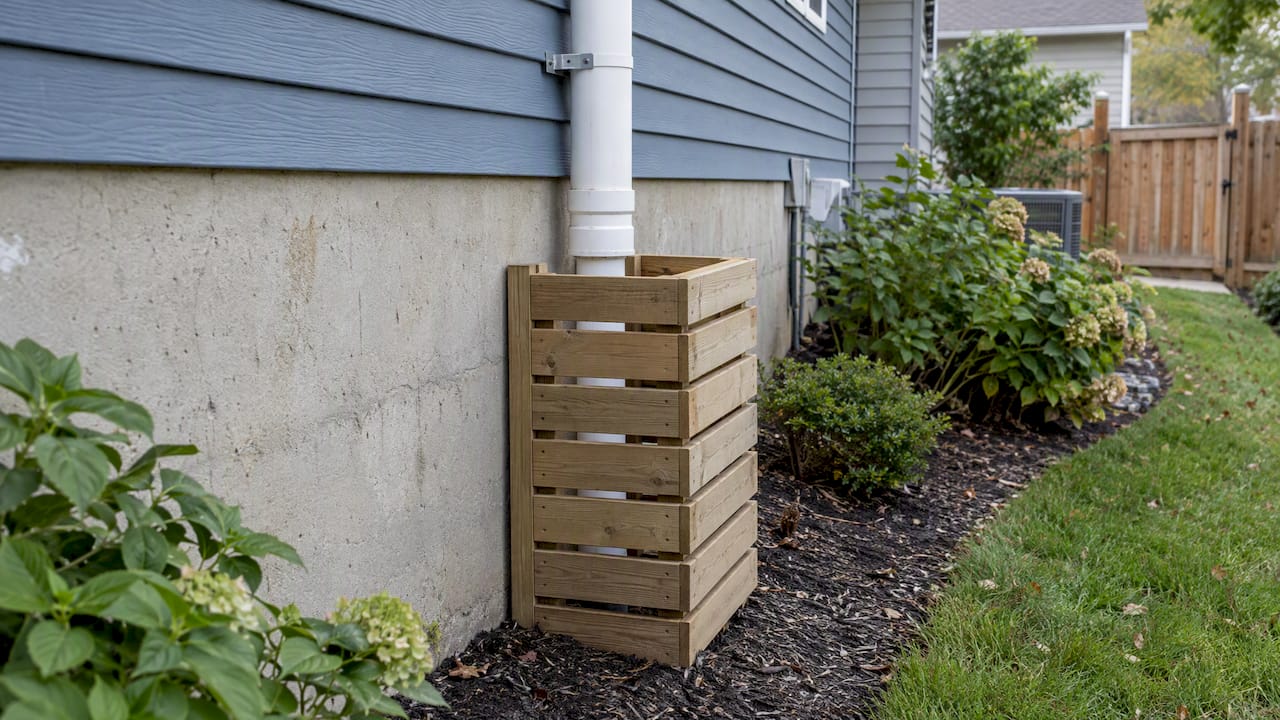
A UK radon industry article on disguising systems describes specialists working with homeowners on discreet, quiet installations, including siting the fan and vent some distance from the house or using false downpipes and guttering to disguise the run (UK Radon, Winter 2011). That is a UK source, so treat it as inspiration. A disguised downpipe still has to meet your local discharge rules and be labeled and reachable.
Hiding a radon pipe inside
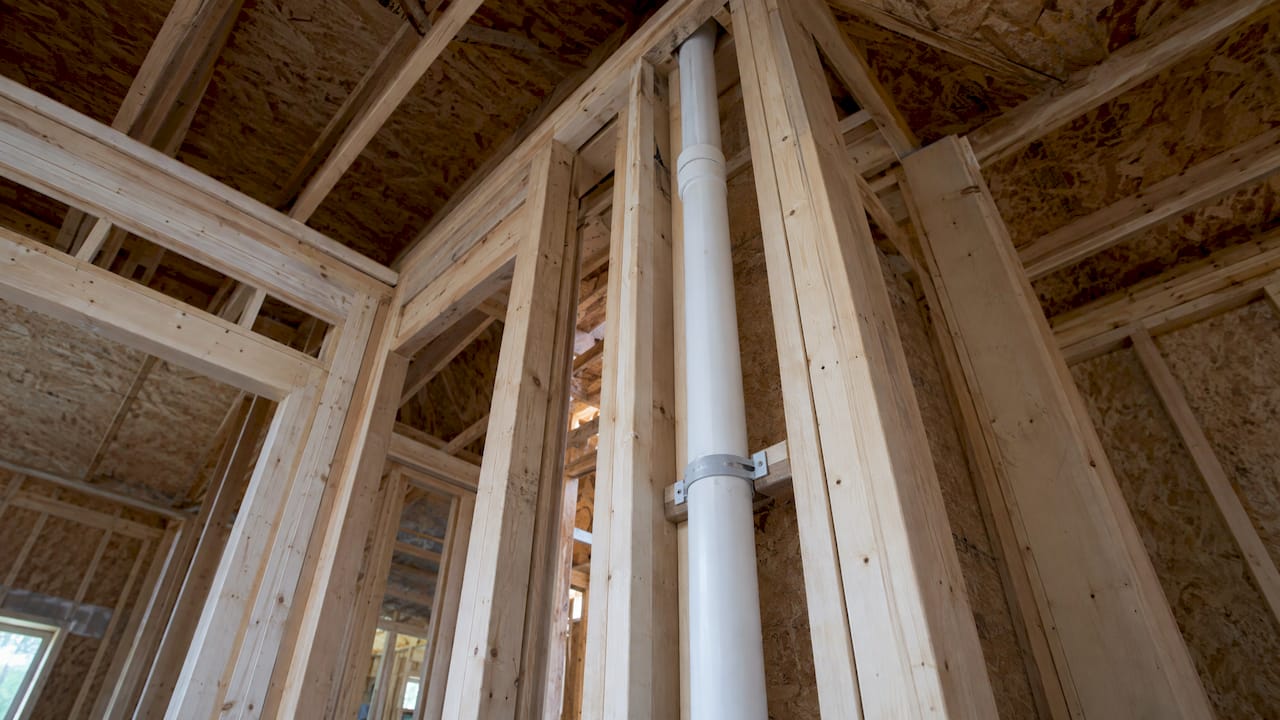
The biggest visual win is an interior route. As one homeowner-facing explanation puts it, the main benefit of an internal setup is that no pipe shows on the outside of the house. The pipe goes up through the house and exits through the roof.
Common places to hide an interior pipe:
- A closet stack. The pipe rises through the corner of a closet on each floor, then through the attic.
- A boxed corner or chase. A framed, drywalled chase can house the pipe like a plumbing stack.
- An existing chase. An unused chimney flue or plumbing chase can sometimes carry the pipe, depending on its condition and clearances.
- A garage or utility room wall. Often the shortest path from the slab to the roof.
Interior routing has limits worth knowing before you plan it:
- The fan cannot live in or below living space. University of Georgia extension guidance states that radon fans must not be located in or below a livable area, including a basement (University of Georgia Extension, 2013). The usual solution is the attic, the garage, or outside. That is why a fully interior route normally ends with the fan in the attic.
- The pipe must stay accessible. Do not close in a chase with no way to look at the pipe or the labels. A removable panel or a clean-out location solves this.
- Labels must be visible. Pennsylvania's code is a good model: when a system is accessible and visible, a description label with the installer's information, the installation date and a re-testing recommendation must be permanently affixed to the piping, and visible interior vent-pipe sections need a label on each floor (25 Pa. Code § 240.308). That is Pennsylvania law, but good installers label systems like this everywhere. When the pipe is concealed, the label goes somewhere prominent nearby.
- Warm routing helps. EPA's builder guidance notes that running the pipe through warm space can use stack effect to create a natural draft in a passive system, and that planning the route before the house is finished improves looks and reduces operating costs (EPA, Building Radon Out).
When a house already has a system, moving it inside means opening walls, so expect drywall and paint work on top of the mitigation work. For a sense of the line items involved, see our radon mitigation cost guide.
What must stay open, visible and reachable
Before you cover, paint or plant anything, check this list.
| Part | What to do | What to avoid |
|---|---|---|
| Vent opening (top of pipe) | Keep open, upward-facing, clear of snow and debris | Caps, decorative hoods, screens over the end, plants |
| Fan | Keep outside living space with air around it and room to service | Airtight boxes, burying it in mulch or soil, closing it in a wall without access |
| System label | Keep it readable, repaint around it | Painting over it or hiding it behind a panel |
| Joints and couplings | Keep clean and visible for inspection | Heavy paint buildup, caulk, wrapping |
| U-tube gauge (manometer) | Leave it where you can see it | Covering it with furniture or a panel |
| Discharge clearances | Keep the distances your installer designed | Moving the end lower or closer to windows |
The fan point deserves emphasis. Guidance on concealment warns against airtight enclosures around fans and says to maintain the required vent clearances (plumbinginto.com). A fan that cannot shed heat or be reached will fail early, and you will pay to open the enclosure anyway.
Homeowners should also get written operating and maintenance instructions for their radon reduction system (California Department of Public Health). If you plan to dress up the pipe, keep those instructions where you can find them. Our guide to what to check on a radon system and when lists the routine checks that a cover must not make impossible.
Ideas that look good but cause trouble
Some popular concealment ideas do more harm than good:
- Artificial living walls or dense foliage panels placed right against the pipe. They can look good lower down, but they block airflow and access if they reach the fan or the top.
- Ending the pipe under the eave or inside a soffit to hide it. Discharge near the eave and near openings is exactly what the clearance rules try to prevent.
- Shortening the pipe so it stays below the roofline. The vent has to disperse radon away from the house, and a low outlet can bring it back to windows and cracks.
- Wrapping the pipe in insulation and tape without telling anyone. A hidden change can mask a leak or a damaged joint.
- Swapping to a different pipe size because it fits a wall better. Size affects airflow, which is why we explain when 3-inch is enough and when to use 4-inch.
We believe the best hiding job is a planned one
We design every system around the foundation first and the appearance second, because a radon system that looks good and does not work is worth nothing to the family living above it. But appearance is a real design input, and homeowners are right to raise it.
Most complaints about ugly pipes trace to a missing conversation. The route was picked by the shortest path, nobody asked about the front elevation, and the homeowner learned about it when the crew left. When we quote, we walk the house with you, look at where the pipe can run on the inside and the outside, and write the route into a fixed quote. That way there are no surprises after quoting, and no added costs for a change you could have asked for on day one.
Our focus is radon mitigation and nothing else, and our installations follow ANSI/AARST standards. Every system also gets post-installation verification testing, because a pipe that blends in is only a success if the numbers come down. If you want to paint, screen or plant around a system we installed, we are glad to tell you what is safe to touch and what is not.
Yoshua
If you are buying, building or remodeling
Timing changes everything.
New construction. A rough-in puts the pipe in during framing, through the interior walls and up through the roof, so nothing needs to hang on the outside. EPA's builder guidance says running the pipe before the house is finished can improve aesthetics and lower operating costs because it can pass through warm space (EPA). Builders who tell us early where the closets, chases and attic access will be get the cleanest results.
Buying or selling. If a radon test during a sale leads to a system, the buyer and seller can agree on placement as part of the deal. Documentation from the verification test helps the transaction, and a tidy installation helps a showing.
Remodeling. If you are finishing a basement or moving walls, build the radon route into the plan. A pipe in a framed chase costs far less than one cut into a finished wall later.
Crawl spaces and unusual foundations. The route depends on the foundation type. Our guide to crawl space radon reduction and the overview of how each mitigation method works show why the pipe lands where it does.
Test after any change near the system
If the pipe was moved, shortened, rerouted or enclosed, test again. University of Georgia guidance says a post-mitigation test should happen no sooner than 24 hours after the system is finished and within 30 days, with a retest every two years (University of Georgia Extension, 2013). Painting the pipe does not change those numbers. A rerouted pipe might. Use our notes on where to place a radon test so the result is reliable.
If the fan is silent, the gauge reads zero, or a recent test is high after you changed something, start with these 8 checks for a radon system that is not working.
When to call a radon professional
Call before you act if:
- You want to move the pipe, the fan or the discharge point.
- You want to enclose any part of the pipe in a box, wall or cover.
- You are not sure whether your local code or HOA rules limit what you do.
- The fan is noisy, the gauge looks off, or the pipe is cracked or loose.
- You are adding rooms, a deck or a roof change that affects the route.
Painting a straight section of exterior pipe or adding plants a few feet away usually does not need a visit. Changing airflow, access or clearances does.
Want it hidden properly?
We design and install radon mitigation systems for homes across the Greater Cincinnati area, with fixed written quotes and verification testing on every job. If your current pipe bothers you, or you are about to install one, talk to us about radon mitigation and tell us which sides of the house matter most. If the fan needs replacing, our radon system repair and fan replacement service is a good moment to reroute or tidy the run.
Not sure yet whether you need a system at all? Start with professional radon testing.
FAQ
Can I paint a radon pipe?
Yes, in most cases. Use exterior, UV-resistant paint made for PVC, clean and scuff the surface first, and keep the labels, joints and vent opening free of paint. If the pipe is part of a system we installed, ask us before painting the fan housing.
Can I cover a radon pipe with a box or enclosure?
Only if the cover is vented and removable. Enclosures that trap air around the fan or block access to the pipe cause problems, and the discharge point has to stay open to the air. When in doubt, have a radon professional approve the design first.
Can I move a radon pipe to the back of the house?
Sometimes, but it is a system change, not a cosmetic one. The new route has to keep the discharge above the roof edge and away from windows and other openings, with the right pipe size and slope. Plan it with an installer and test the result afterward.
Can I hide the pipe with plants?
Yes, at the lower section. Keep plants and mulch off the pipe, leave a clear path to the fan, and never block or wrap the top where the radon exits.
Sources
- Mitigation System Vent Pipe Installation Requirements, Iowa HHS (2022)
- 25 Pa. Code § 240.308, Radon mitigation standards
- Building Radon Out, EPA
- Radon Mitigations: DOs and DON'Ts, University of Georgia Extension (2013)
- Radon Fix, California Department of Public Health
- Disguising radon remediation, UK Radon (Winter 2011)
- How to Hide a Radon Pipe Outside, plumbinginto.com