
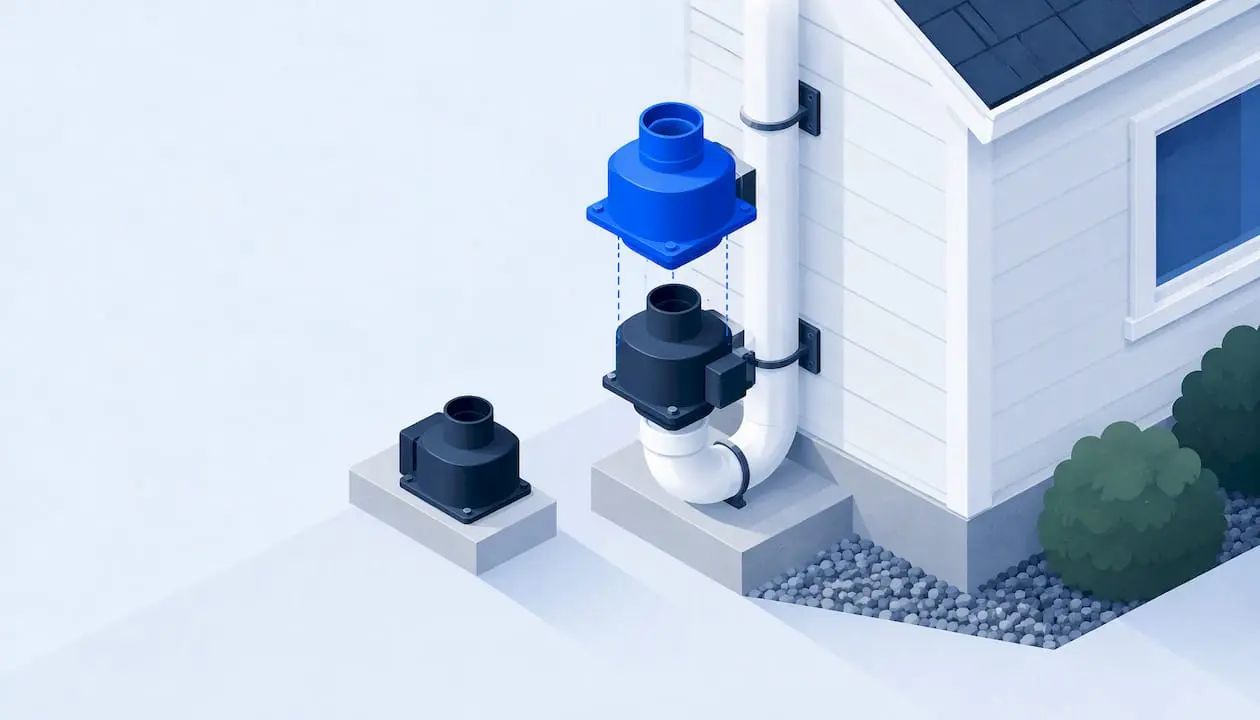
A radon fan that has stopped working means your mitigation system has stopped working. Replacing it typically costs around $200 to $350 including parts and labor, according to the EPA, and the job usually takes a technician a short visit. What matters more than the price is getting the right fan, installing it in the right place, and testing afterward to confirm your home is back below the action level.
This guide covers how long radon fans last, the signs one is failing, what replacement costs, how to pick a compatible unit, and where a homeowner's job ends and a licensed professional's begins.
TL;DR
- Radon fans may last five years or more, and manufacturer warranties generally do not run longer than five years, per EPA guidance.
- The EPA puts a typical replacement at roughly $200 to $350, parts and labor included. Your cost moves with the fan model, the pipe layout and the electrical work.
- A silent fan, a fan that is unusually loud, or a manometer reading that has gone flat all point to a problem. Do not wait for the next scheduled test.
- Match the new fan to the old one's specifications and keep the failure warning device in place. Then retest the home.
- If the fan is hard to reach or the wiring is not straightforward, have a radon professional do it.
Table of Contents
- How long a radon fan lasts
- Signs your radon fan needs replacing
- What radon fan replacement costs
- Choosing a replacement fan that fits
- Can you replace it yourself?
- What a professional replacement looks like
- Test after you replace the fan
- Our perspective: replace the fan, but look at the whole system
- Need a fan replaced in Greater Cincinnati?
- FAQ
- Sources
How long a radon fan lasts
A radon fan is the only moving part in most active systems, and it runs around the clock. The EPA's consumer guide says active systems must run continuously to work correctly, and that fans may last five years or more before they need repair or replacement.
In practice, "five years or more" is a floor, not an expiry date. Plenty of fans run well past their warranty. Others fail early because of moisture in the pipe, a bearing wearing out, or a power surge. That is why a fan with no obvious symptoms still deserves a check at least once a year. We walk through that routine in our guide to radon system maintenance.
One cost note: a running fan uses little electricity compared with the cost of a high-radon home, but you pay for it every day, so an old, inefficient or struggling motor is worth replacing sooner rather than later.
Signs your radon fan needs replacing
Most homeowners find out in one of four ways.
The fan is silent
A working fan makes a low hum or whoosh. If you stand near the pipe in the basement, garage or attic and hear nothing, and the circuit breaker has not tripped, the motor may have died. Check the breaker and the switch first. A tripped breaker is a free fix. A dead motor is not.
The fan is unusually loud
Grinding, rattling, buzzing or a rhythmic knock suggests worn bearings or a loose impeller. Liberty+'s homeowner guide says a fan that is unusually loud or cannot be heard may need replacement. A noisy fan can run for a while, but it is on borrowed time.
The manometer or alarm has changed
Most systems have a U-shaped gauge on the pipe, called a manometer, or an electronic alarm. The EPA says the system should keep a visible or audible warning device that signals failure. If the two liquid columns in the gauge sit level, there is no suction. Before you assume the fan is dead, read our short piece on the manometer zeroing check, since a misread gauge is a common false alarm.
A radon test comes back high
Sometimes the first sign is a retest. If a short-term test or a continuous monitor shows levels at or above 4 pCi/L in a home that was previously mitigated, the fan is one suspect among several. Cracked pipe joints, a blocked vent, or a changed slab can also be the cause. Our eight homeowner checks help you sort out what is likely before you book a visit.
What radon fan replacement costs
The EPA's figure is the one to anchor on: around $200 to $350 for a replacement, parts and labor included. Here is what moves a job toward the low or the high end of that range.
| Factor | Effect on cost |
|---|---|
| Fan model and size | Larger, higher-suction fans cost more than standard inline units |
| Access | A fan in an open garage or attic is quick; a tight crawl space takes longer |
| Pipe changes | A like-for-like swap needs little piping work. A different diameter needs couplings or adapters |
| Electrical | A working outlet or existing wiring is simple. Hardwiring or relocating a junction adds labor |
| Post-swap testing | A follow-up radon test confirms the result and may be priced separately |
The reason the same fan can cost different amounts is mostly labor and access, not the part. A replacement is also not the only thing a visit might involve. If the technician finds a cracked joint or a missing seal, that repair goes on top.
We do not publish a flat price for fan replacement, because it depends on your fan and your pipe run. What we do is give a fixed written quote after we see the system, with no added costs after quoting. If you want to see how we think about pricing for full systems, our Cincinnati radon mitigation cost guide lays it out.
Choosing a replacement fan that fits
A radon fan is not a generic exhaust fan. It is sized to move air against the resistance of the soil, the pipe and the slab under your house. Put the wrong one in and you can end up with too little suction, too much noise, or a system that technically runs but does not lower radon.
Start with the old fan's label
The model number on the fan housing is the best starting point. Manufacturers publish replacement tables for older models. RadonAway, a fan maker, says its replacement guide lists matching units that often require little or no piping changes, and invites you to contact them if your fan is not listed.
A supplier blog adds a useful caution: if a fan brand does not appear in the established replacement guides, that may point to a high failure rate or a product not built for radon. It is one supplier's view, but it fits what we see. If the fan on your pipe has no recognizable radon-specific brand, do not simply copy it.
Keep the original design intent
The fan was chosen when your system was designed, based on the foundation, the soil and how many suction points there are. That is why we start every job with site-specific design instead of a catalog guess. See how that works in our article on system design for Cincinnati homes. Replacing with a "similar" unit that has a very different airflow rating is how people end up with a system that is louder or weaker than before.
Check where the fan sits
The EPA says a replacement fan should be in an unconditioned location, not in or below a livable area, and an exterior fan must meet local building codes. A fan in a finished basement room, for example, is a problem because any leak in the pressurized side of the pipe puts radon-laden air into your living space. If your fan is somewhere questionable, a swap is the moment to fix it. Our page on radon fan location covers where it belongs and where it never should go.
Mind the pipe size
Some older systems use 4-inch pipe on one side and 6-inch on the other with transitions. A fan with a different inlet size needs adapters, and every added coupling is a place for an air leak. Keep transitions to a minimum and seal them properly.
Can you replace it yourself?
Some people can. Many homeowners who are comfortable with basic wiring and have easy access to the fan do change one. The general steps from Liberty+ are: photograph the connections, disconnect power and the fan from the pipes, remove it, install a replacement with the same specifications, then secure and seal the connections, reconnect power, check for steady operation and air leaks, and test the home.
That sounds simple, and with an easy-access fan it often is. Here is where we would stop and call someone:
- The fan is hard to reach. Liberty+ itself suggests a professional when the fan is in a tight corner or small crawlspace.
- The wiring is hardwired or unclear. Mistakes here are a shock and fire risk, not just a performance issue.
- You do not know what the original fan was. An unmatched fan can quietly leave your home above the action level.
- You suspect the problem is the system, not the fan. A new fan on a cracked or clogged system will not fix anything.
- You cannot verify the result. Without a post-swap test you do not know whether the system is working.
On the question of do-it-yourself radon kits as an alternative to replacing a failed fan: a fan is one part of a designed system, not a stand-alone fix. The CDC states that lowering high radon levels requires technical knowledge and special skills, and that an unsuitable contractor can make the problem worse. That applies even more to a home built around a system you did not design. A fan swap on an existing system is a reasonable DIY job for some. Building or re-engineering a system from a kit is a different matter.
Ohio also licenses radon professionals. State law, Section 3723.06 of the Ohio Revised Code, sets out the application and renewal process for radon mitigation specialist and contractor licenses. If you hire someone for new installation or substantial work, ask to see their license.
What a professional replacement looks like
A good visit is not just "unbolt, bolt, leave." This is what we do:
- Inspect the existing system. We check the fan, the pipe run, joints, the vent termination, the condensation drain-back and the manometer.
- Identify the fan and match it. We use the model, the system's design, and the measured suction to choose a replacement, not just a similar-looking one.
- Swap and seal. Power off, remove, install, seal each coupling, restore power.
- Verify suction and airflow. We confirm the manometer reads correctly and that the fan runs smoothly.
- Recommend a test. The follow-up radon measurement tells you the home is protected.
That is the same site-specific approach we bring to new installs and the same verification mindset, applied to repair. Details of the service are on our radon system repair and fan replacement page.
Test after you replace the fan
A new fan humming is not proof of a safe home. The CDC says that after installing a system you should test the home again to make sure it is working. The same logic applies after a fan replacement. The EPA's guidance for new systems recommends a post-mitigation test within 30 days and an independent follow-up measurement. For a fan swap on an existing system, use the same approach as a sensible standard: test soon after, and again later.
A short-term test is the fastest way to confirm. If you have a continuous monitor, check its readings over several days. If you do not own one, our radon testing service provides it, which also matters if you need documentation for a real estate transaction.
Radon control systems are mechanical and can deteriorate and eventually fail, which is why performance indicators should be checked regularly. Put a reminder on your calendar for the manometer: once a month is a reasonable habit, and a full retest every couple of years is a common recommendation.

Our perspective: replace the fan, but look at the whole system
Most fan calls we get begin with the same sentence: "I just need a new fan." Sometimes that is exactly right. A five- or ten-year-old motor has simply given out, and a like-for-like swap solves it.
But a dead fan is also a chance to ask why. Was it overworking against a blocked pipe? Did water collect in the line? Has the slab cracked, or has a sump pit lid come off? In Greater Cincinnati, where the geology produces elevated radon in many homes, the system is doing real work year-round, and the fan is the part that shows the strain first.

So we treat a fan replacement as a short system check. We match the new fan to the old one's design, look at the pipe and seals, and confirm with a test. We do not add costs after we quote, and we do not oversell. If a fan is all you need, the quote says so.
Radon is our only focus, which is why we are comfortable telling you when the job is small.
— Yoshua
Need a fan replaced in Greater Cincinnati?
If your radon fan is silent, noisy or past its warranty, we can inspect the system, quote the swap in writing, and verify with a test. Our radon system repair and fan replacement service covers residential, real estate and multi-family properties. Fixed written quote, no added costs after quoting.

If you are not sure whether a repair or a full system makes sense, our page on radon mitigation systems explains the options by foundation type.
FAQ
How many years does a radon fan last?
The EPA says radon fans may last five years or more, and manufacturer warranties generally do not exceed five years. Some run far longer, others fail sooner. Check the manometer monthly and have the system looked at if the fan gets loud or goes quiet.
How much does it cost to replace a radon fan?
The EPA gives a figure of around $200 to $350 including parts and labor. Access, fan model, piping adapters and electrical work move the price within or beyond that range. A fixed written quote before work starts avoids surprises.
Can I replace a radon fan myself?
If the fan is easy to reach and you are comfortable disconnecting power and sealing pipe joints, it is possible. Choose a replacement with the same specifications and test the home afterward. If the fan is in a tight space, the wiring is unclear, or you are unsure what to buy, hire a radon professional.
Do I need to test radon after replacing the fan?
Yes. The CDC says to test again after installing a system to make sure it is working, and a fan swap changes the one part that drives the suction. A short-term test soon after the swap is the quickest confirmation.
What happens if my radon fan stops working?
The system stops pulling radon from under the house, so levels can climb back toward where they were before mitigation. Because active systems must run continuously, treat a dead fan as urgent and arrange a replacement promptly.
Sources
- EPA: How do I know if my radon mitigation system is working properly?
- EPA: Consumer's Guide to Radon Reduction
- CDC: Reducing Radon Levels in Your Home
- RadonAway: Radon Fan Replacement Guide
- PDS Radon Supply: Radon Fan Replacement Guide
- Liberty+: Replace a radon mitigation fan
- Ohio Revised Code Section 3723.06
- Boulder County: Operation, Maintenance and Monitoring Plans for Radon Control Systems